
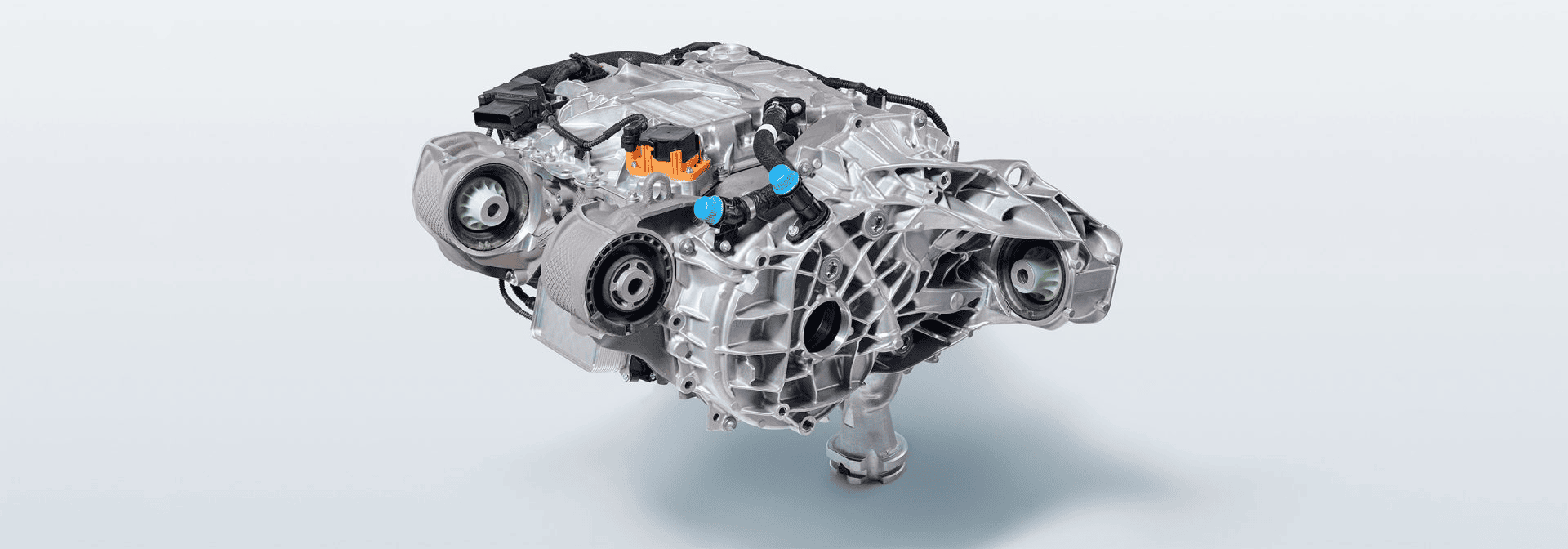
Image source: BMW Gen6 Electric Drive System ( Electric drive systems are cited as a current industry example. TGM has no business or organizational ties to electric drive systems.)
BMW's sixth-generation electric drive system (Gen6) represents a paradigm shift - from component-based electrification to a fully integrated drive system within the New Class architecture. Instead of considering the motor, inverter and battery as separate units, BMW has developed them as a tightly coupled energy system.
This enables scalable configurations - from efficiency-oriented single-motor layouts to powerful multi-motor systems - while maintaining a consistent system architecture. The result is a modular and standardized platform that supports both production efficiency and cross-vehicle optimization of future electric models.
The technology
At its core, Gen6 is based on a completely new development centered around an 800-volt architecture and next-generation cylindrical battery cells. This combination enables significantly faster charging times, improved thermal behavior and a higher energy density.
The use of silicon carbide (SiC) semiconductors in the inverter reduces switching losses and increases the overall efficiency of the drivetrain. At the same time, BMW has optimized the motor, power electronics and control software across the entire system, achieving efficiency increases of around 20 %.
The integration of central computing architectures also enables real-time optimization of energy flows, thermal management and performance characteristics.
The lightweight construction aspect
From a lightweight design perspective, Gen6 shows a clear transition from component optimization to holistic lightweight system design. By integrating the motor, inverter and transmission into a compact architecture, BMW has reduced redundant interfaces, connecting elements and structural overlaps - resulting in an overall weight reduction of around 10 %.
In addition, simplified electrical architectures help to reduce the wiring mass by up to 30 % - a decisive lever in modern electric vehicles.
Another key enabler is the potential use of topology-optimized housing structures for the electric drive. This involves designing motor and inverter housings along real load paths instead of following conventional geometric restrictions. The material is therefore only used where it is structurally required.
The result is organic, ribbed geometries that ensure rigidity and durability while significantly reducing weight. In combination with modern casting processes or additive manufacturing, such housings not only enable weight reduction, but also improve heat dissipation and the integration of fastening and interface structures.
Overall, Gen6 shows that the next stage of lightweight construction in electric drive systems is based on three central principles: functional integration + topology-driven structures + system simplification - and no longer on isolated material substitution.
Read the full article here: https://www.bmwgroup.com/en/news/general/2025/gen6-electric-drive.html
 Deutsch
  English