
The engine block and gearbox housing of the VW Beetle were already made of magnesium. The little Lupo also had components made of it. After a shadowy existence, the light metal could shine again ...
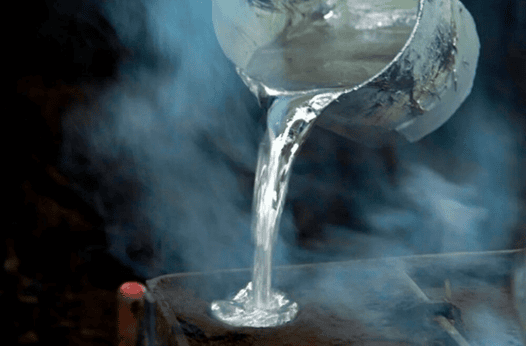
View of the manual casting process of a magnesium part. With a few exceptions, the light metal actually leads a shadowy existence as an industrial material. However, Freiberg researchers are now in the process of making magnesium much more attractive in terms of costs and sustainability.(Image: Metal Master)
Although magnesium is lighter than aluminum, it was only found sporadically in industry. This is particularly surprising in times of lightweight construction requirements, which are intended to save fuel and energy. One reason for this is that the processing of magnesium is considered complex and, above all, energy-intensive. And when magnesium burns, it's no fun, because you can't fight the fire with conventional extinguishing agents. However, the Technical University Bergakademie Freiberg (TUBAF) is now working on making magnesium not only an attractive but also a climate-friendly material for industry, which could give a new boost to lightweight construction.
Less energy and CO2 during magnesium processing
A team from various departments at TUBAF has worked with industrial partners to forge an end-to-end process chain for lightweight magnesium components, which extends from the melt to the functional prototype, according to the report. Energy requirements and CO₂ emissions have been reduced across all process steps - thanks to the use of hydrogen in the melting and heating technology, shortened processes and a cold-formable magnesium alloy, among other things. Among other things, the research alliance has produced lightweight magnesium computer housings, rail seat back walls for high-speed trains such as the TGV, hinge parts for transport containers and an airflow channel for a hovercraft rescue vehicle.
Casting rollers reduce the effort required for forming
Starting with sheet metal production, the Freiberg team at the Institute of Metal Forming is relying on innovative processes to achieve this, it continues. Magnesium sheets with a thickness of around five millimetres can already be produced using casting rollers. This means that downstream forming steps can be reduced. The result is magnesium components that are around a third lighter than their aluminum counterparts with comparable strength. This means that the potential of magnesium as a lightweight material can be better exploited in future - for example for e-mobility, in mechanical and vehicle engineering or in medical technology.
At the TU Bergakademie Freiberg, so-called casting-rolling is also used for the forming of magnesium in order to bring the light metal close to the desired contour more quickly and cheaply. This saves some of the usual forming steps.(Image: TUBAF)
Three building blocks for climate-friendly magnesium processing
The first component of the new manufacturing process was the development of ways to replace fossil fuels with up to 100 percent climate-neutral hydrogen. The conversion of the melting and heating processes to hydrogen and their energy-efficient restructuring is a key step towards producing magnesium in a climate-neutral and cheaper way in the future. Once again, the researchers are using digital twins to better understand the processes and, above all, to improve operations. A second lever is the significantly shortened process route. The team is relying on the casting-rolling process integrated at the Institute of Metal Forming to quickly convert the molten magnesium into a primary product. The heat from the casting process is used directly for forming, resulting in sheets or wires that already have almost the desired component shape and dimensions. Energy and time-consuming downstream process steps can thus be reduced. The third component used is the calcium-containing magnesium alloy ZAX210. It can be processed well even at relatively low forming temperatures of around 200 °C. The alloy makes it possible to carry out forming processes at significantly lower temperatures without compromising on the component properties.
Specialties in the new processing of magnesium alloys
The research team also developed the „GieWaCon“ process specifically for wire production with magnesium, which combines wire casting rolling with the Conform process, which is already established for copper and has now been transferred to magnesium for the first time, as they emphasize. Because the process works at room temperature, the heat present in the casting process can be used to directly manufacture a wire product in just a few process steps. The magnesium wires produced in this way ultimately have a diameter of 1.6 millimetres - achieved either directly using the conform process or by subsequent wire drawing. The project also shows that the principle of the shortened process route can also be transferred to other forming processes. For example, the magnesium alloy used was successfully forged; the resulting components were reworked immediately after forming, for example by deburring or milling. In addition, an industrial partner developed an extrusion process in which billets are first cast and then extruded from the casting heat. The resulting tube is cut and bent open so that it can be processed into sheet metal - also without additional heating steps.
Welding and coating complement magnesium research
In addition, suitable surface coatings were investigated for all prototypes in order to ensure corrosion resistance and the usability of the magnesium components under real conditions, as we learned from Freiberg. In addition, the project team analyzed and optimized various welding processes, which were specifically adapted to the magnesium alloy used and further developed for the respective demonstrators.
Together with the industrial partners, the team now wants to further advance the developed production routes in the future and apply them to other components and forming processes. A CO₂ calculator, which companies can use to compile and compare possible process chains for the forming of magnesium, has been developed specifically for this purpose as part of the project. The whole thing is called the CLEAN-Mag app: reducing emissions in industrial processes.
Find out how TGM turns the potential of lightweight products into certified reality:
 Deutsch
  English