
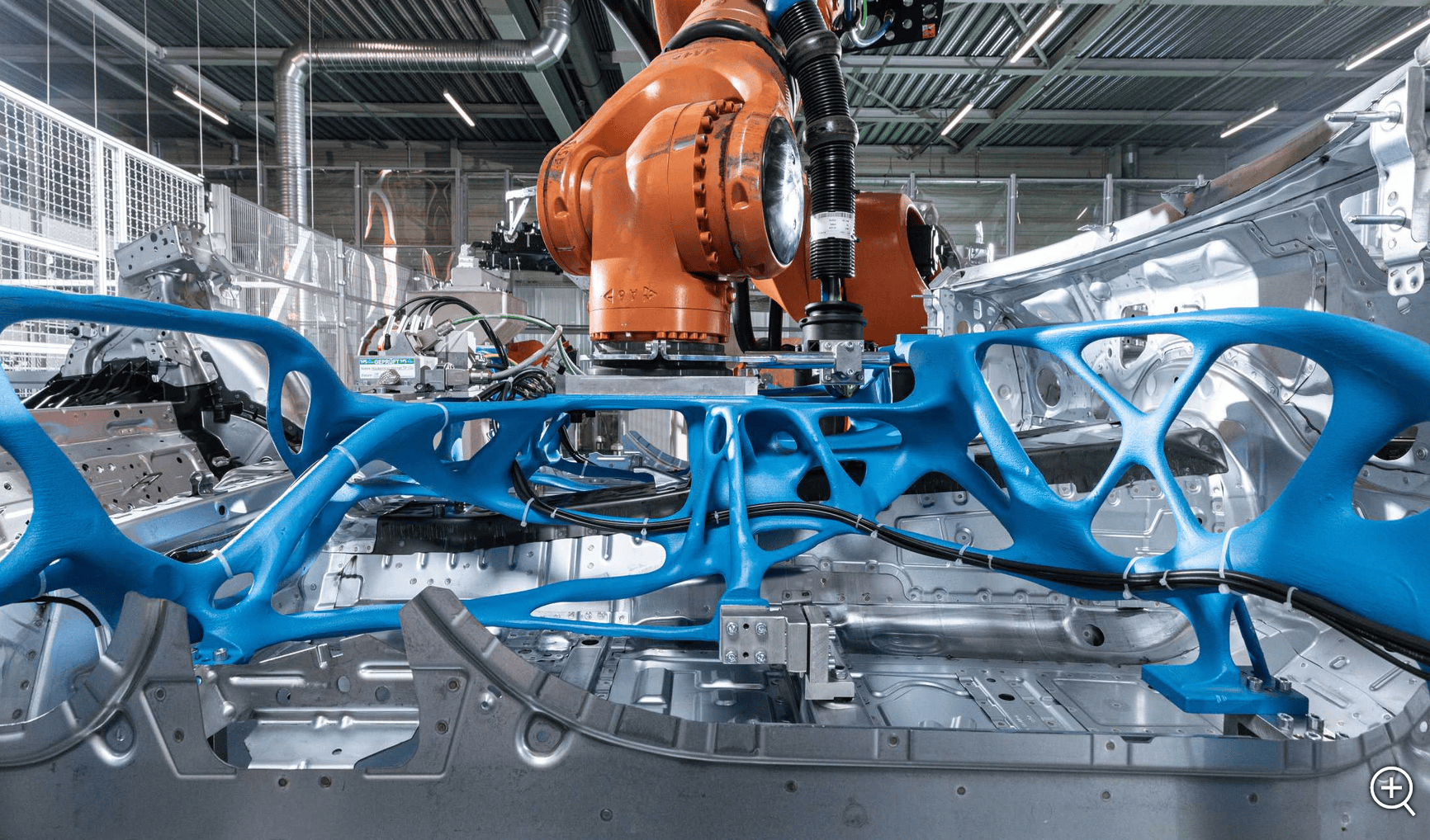
Image source: BMW · PressClub Global ( A robotic gripper system is cited as a current industry example. The robotic gripper system has no business or organizational connection to TGM.
BMW's robot gripper system is designed as a material handling end effector for various manufacturing processes, including CFRP roof production, door handling and the transfer of complete floor assemblies in BMW plants such as Landshut, Regensburg and Munich.
The gripper systems perform repetitive pick-and-place processes in which precision, speed and durability are crucial. At the Landshut plant, for example, a robot gripper loads raw carbon fiber material into a press and then rotates 180 degrees to remove the finished CFRP roof. At the Munich plant, an even larger gripper handles the complete floor assembly of the BMW i4.
These systems are no longer just passive tools, but are evolving into highly optimized structural systems that have a direct impact on robot efficiency, production throughput and operating costs.
The technology
BMW uses additive manufacturing technologies such as Selective Laser Sintering (SLS), Large Scale Printing (LSP) and sand-based 3D-printed molds to produce customer-specific robot grippers.
SLS is used for smaller functional components such as vacuum suction units and clamping mechanisms, while LSP enables the rapid production of large structural housings from recycled plastics and injection molding granulate.
For complex bionic geometries, BMW uses topology optimization software such as Synera to generate organic load paths that would be almost impossible to realize with conventional manufacturing methods.
These digital development processes significantly reduce the time from design to production. For example, a 120 kg gripper can be manufactured in just 22 hours, while at the same time enabling rapid adaptation to different manufacturing tasks.
The lightweight construction aspect
The most significant engineering achievement lies in the lightweight design strategy of these systems. The first generation of 3D-printed grippers was already around 20 % lighter than conventional solutions, which reduced wear on the robots and extended maintenance intervals.
The next generation of bionic grippers achieved an additional weight reduction of 25 % through topology optimization. As a result, a single robot can take on tasks in CFRP roof production that previously required three robots.
At the Munich plant, the gripper for the floor assembly weighs just 110 kg and is therefore around 30 % lighter or around 50 kg lighter than conventional alternatives.
This weight reduction lowers the inertial loads, enables higher robot accelerations, reduces the energy consumption of the actuators, allows the use of smaller robot systems and reduces CO₂ emissions by almost 60 % when using recycled materials.
BMW's approach impressively demonstrates how lightweight construction is increasingly extending beyond vehicle structures to automation and production systems - and how production tools themselves are becoming high-performance technical structures.
Read the full article here: https://www.press.bmwgroup.com/global/article/detail/T0442351EN/bmw-group-expands-use-of-3d-printed-customised-robot-grippers
 Deutsch
  English