
Glass surfaces in modern vehicles are becoming increasingly larger. Panoramic roofs, extended windscreens and integrated displays increase the proportion of transparent components - and therefore their contribution to the overall mass of the vehicle. Conventional automotive glass, usually based on laminated safety glass, offers robustness and safety, but is associated with a weight disadvantage that has a direct impact on efficiency.
With Gorilla Glass, Corning Incorporated has transferred a material originally developed for consumer electronics to the automotive sector, thereby opening up new lightweight construction potential in vehicle glazing.
Originally introduced for smartphones and tablets, Gorilla Glass is a chemically toughened aluminosilicate glass. Through an ion exchange process, larger ions are introduced into the surface, creating compressive stresses that significantly increase strength and damage resistance compared to conventional glass. For the automotive sector, this technology is transferred into hybrid glass constructions, which typically consist of a thin Gorilla Glass outer layer and a conventional glass layer on the inside. The result is a glazing system that meets safety requirements while reducing thickness and mass.
The main lightweight construction advantage lies in the reduced material thickness with comparable mechanical performance. Compared to conventional laminated glass, weight reductions of up to around 30 % can be achieved with Gorilla Glass-based solutions - depending on the application. This is particularly relevant for large-surface components such as windscreens, side windows and panoramic roofs, where both thickness and surface area contribute significantly to the overall mass. In the roof area in particular, a reduction in mass also leads to a lower center of gravity, which has a positive effect on driving dynamics.
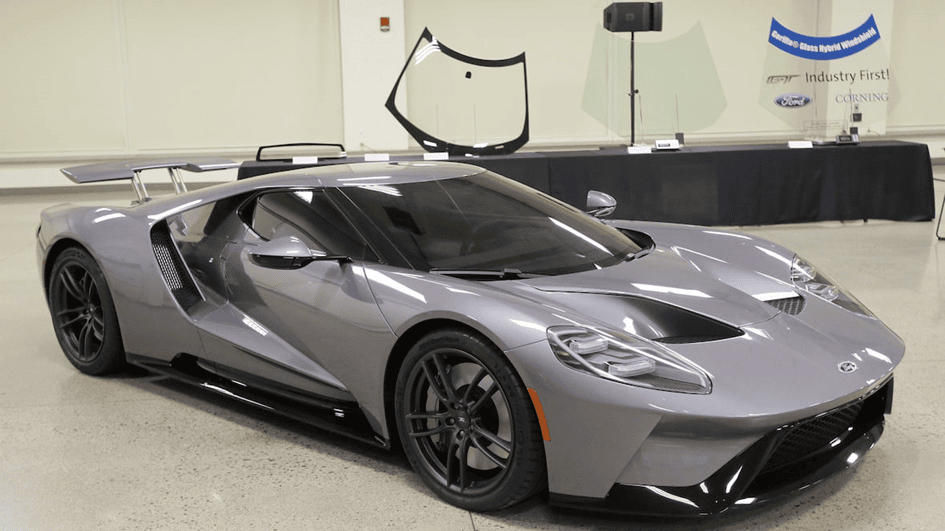
Several OEMs have already implemented Gorilla Glass in production vehicles, demonstrating its industrial feasibility. The Ford GT is one of the early examples, using Gorilla Glass for the windshield and engine cover as part of a comprehensive lightweight strategy. The Jeep Wrangler introduced Gorilla Glass as an optional windshield to increase stone impact resistance while reducing weight. In vehicles such as the BMW i8, advanced glazing concepts complement a holistic lightweight architecture.
In addition to pure weight reduction, Gorilla Glass enables improved scratch and stone chip resistance as well as greater design freedom thanks to thinner and more complex geometries. The high optical quality also supports applications in vehicle interiors, where the material is increasingly being used for display covers and touch surfaces, replacing heavier materials.
Especially in electric vehicles, where efficiency correlates directly with mass, weight reduction is becoming increasingly important. At the same time, large glass surfaces are used specifically to increase the feeling of space and comfort - a classic conflict of objectives between design and lightweight construction. Gorilla Glass offers a solution here by enabling large transparent surfaces with reduced mass and thus supporting both efficiency and user experience.
Even if the weight saving of individual glazing components initially appears moderate, the combination of windshield, side windows and roof glazing results in a significant systemic effect. This illustrates how the further development of even established components such as vehicle glass can open up substantial lightweight construction potential.
 Deutsch
  English