
Why 2 MW of electric drive power is decided less by „chain efficiency“ than by power density, BoP mass, thermal integration and center of gravity position
Technical introduction
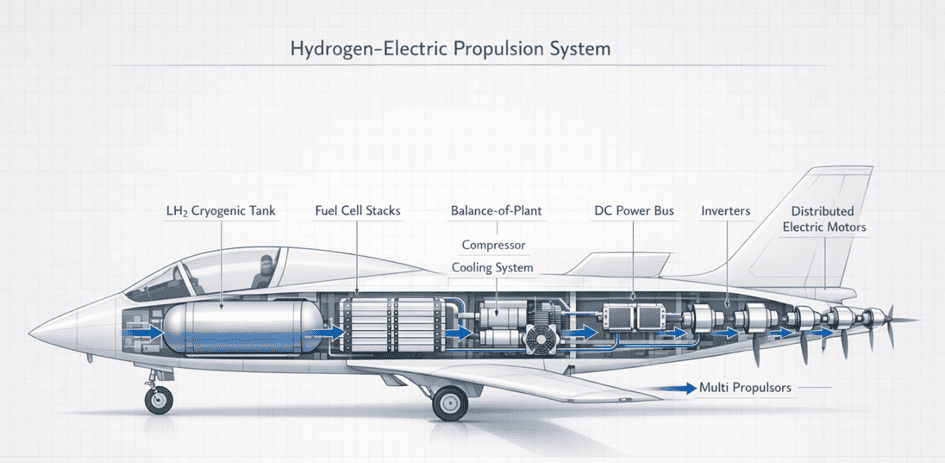
Military aircraft operate under a different triangle of constraints than civilian aircraft: in addition to range and operating costs, mission endurance, signature (acoustic and IR), available electrical power for sensors/communication and robust redundancy are crucial. As a result, hydrogen in combination with fuel cells and electric drives appears attractive on paper: high specific energy of the energy carrier, potentially high system efficiency and the possibility of geometric distribution of propulsors.
In practice, however, feasibility is rarely limited by the „energy chain“ itself. The consequences for mass and integration are decisive: stack power density, balance-of-plant (BoP) mass, heat dissipation, cabling and protective architecture, structural reinforcements - and above all weight & balance (center of gravity position, center of gravity migration and mass moments of inertia). With the introduction of distributed propulsion systems, the central question shifts from „How efficient?“ to „How integrable, controllable and permissible is the mass distribution across all configurations and mission phases?“
Technology classification
Public demonstrators and design studies show two consistent trends:
- Multi-megawatt fuel cell systems are moving from laboratory scale to application-relevant demonstration levels. Airbus reported on a successful „power-on“ of a 1.2 MW fuel cell demonstrator (including electric motors and cooling) as a step towards hydrogen-based drive architectures.
- NASA work in the context of CH2ARGE emphasizes systematic design and trade studies for hydrogen-electric aircraft and explicitly emphasizes that, in addition to the stack and tank, fluidic, cryogenic and thermal management systems in particular have a decisive influence on feasibility and mass balance.
Both sources lead to the same engineering conclusion: The hurdle is not the basic functionality - but the scaling to aviation-relevant power densities with manageable integration and mass properties.
Engineering interpretation
At system level, the architecture „LH2 → fuel cell → DC bus → inverter → motor → propulsor“ only forms the first layer. For military applications, a second layer dominates: payload variability and redundancy behavior.
- Redundancy benefits from distributed electrical propulsors (N-1 / N-2 degradation), but increases cable mass, protection hardware and structural effort, and places higher demands on rotor dynamics and gap control.
- Mission variability (sensor pods, communication systems, external loads, modular kits) influences not only the total mass, but above all its distribution - with a direct influence on the center of gravity and moments of inertia, often more critical than the absolute mass itself.
This is why lightweight construction is inseparable from weight management and mass properties: mass budgets, center of gravity budgets and inertia budgets must be defined top-down and secured bottom-up at an early stage. Otherwise, local optimizations will result in a heavier, more unstable overall system or one that is outside the CG limits.
Lightweight construction analysis
1. system effects
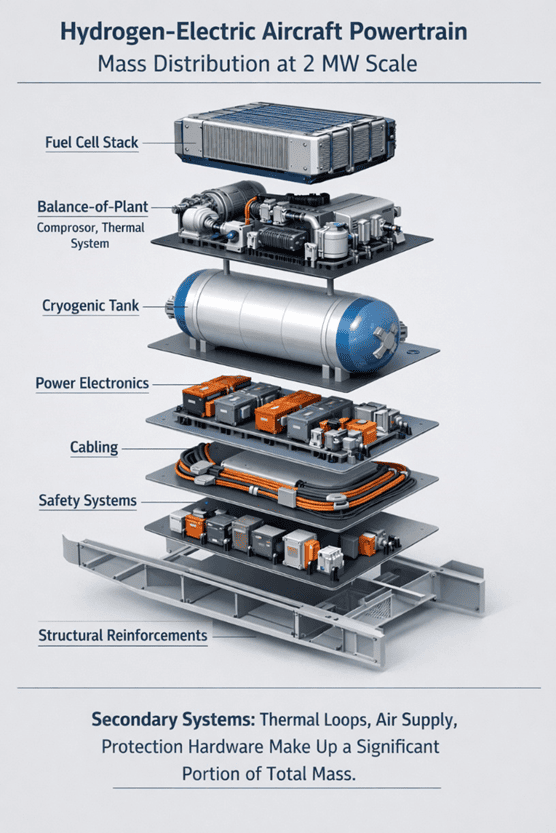
- Stack power density plus BoP remain the dominant control variables. In the 2 MW range, air supply (compressor), water and thermal management, sensors, redundancy and control do not scale „quietly“ - they can dominate the mass and have a decisive effect on the architecture. NASA studies underline the importance of these subsystems.
- Coupling of secondary power requirements: Larger heat exchanger surfaces generate pressure losses; higher stack pressure increases compressor requirements; higher peak electrical power drives inverter, cable and protection dimensioning. The result is a classic system circuit in which mass and efficiency are coupled non-linearly.
2 Structural implications
- LH2 integration is a structural decision, not just a tank issue: tank position, crash zones, venting paths and maintainability influence load paths and reinforcements.
- Distributed drives change loads: external propulsors increase bending and torsional requirements and drive rigidity and structural mass - often more than the pure motor mass would suggest.
- In rim fan/perimeter bearing concepts, gap control, stiffness and rotor dynamics are the primary drivers. Conservative design quickly leads to additional structural mass if not counteracted early on with FEM-based concept design.
3. material implications
- Lightweight material construction here means less „high-end materials“ than functionally appropriate materials and connections across temperature and safety zones: cryo-compatibility, insulation, fire protection as well as HV insulation and EMC requirements.
- Topology/topography optimization only makes sense if integration boundary conditions (inspection, cable routing, shielding, production) are taken into account - otherwise secondary masses are created by brackets, protection and mounting.
4. secondary mass effects
Hydrogen-electric architectures are often dominated by secondary masses:
- Thermal circuits (pumps, heat exchangers, distributors, reserves)
- Air supply/compressor as well as filtration and soundproofing
- HV switching and protection technology, EMC shielding
- Safety infrastructure (detection, ventilation, insulation, fire protection)
- Maintenance access and structural reinforcements through packaging
NASA studies emphasize the central role of these integration systems.
5. weight & balance consideration
For military aircraft, weight and balance is not a documentation issue, but an architecture-defining factor:
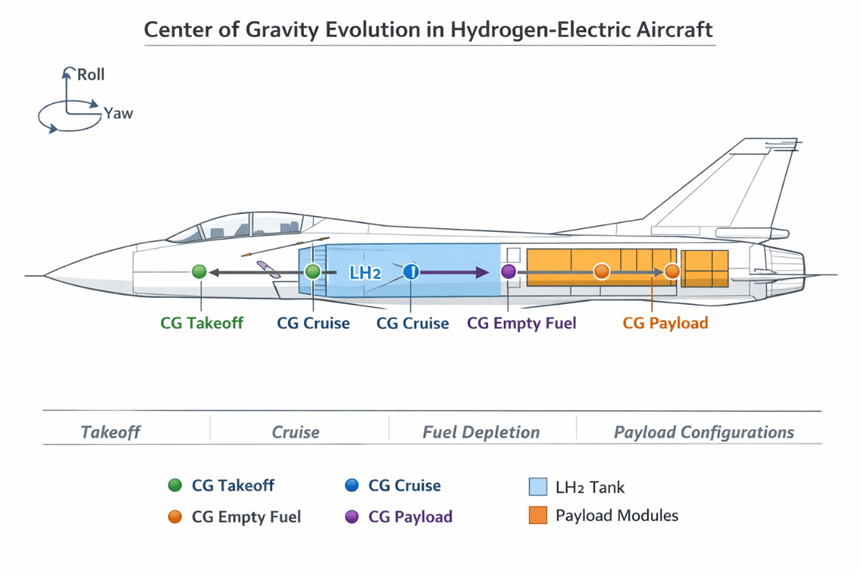
- Center of gravity position and migration: LH2 tanks and modular payloads generate different CG curves than kerosene tanks. Without CG budgets defined at an early stage, ballast solutions or structural countermeasures arise - both of which destroy lightweight construction potential.
- Mass moments of inertia: Distributed propulsors and external systems increase roll and yaw inertia, which influences flight behavior, control and failure modes and can lead to the re-dimensioning of tail units and structures.
- Local vs. systemic savings: A lighter motor is not a win if it forces longer cables, more protective hardware or less favorable CG locations. System lightweighting means reducing mass where it improves mass properties.
Risks & decision relevance
Three risks dominate early go/no-go decisions:
- Performance density risk (stack + BoP): If target values are missed, this has a direct impact on the mission and payload.
- Thermal-cryogenic integration risks: Cooling and insulation are core functions - deficits lead to cascade effects (derating, redundancy, mass increase).
- Mass properties: Late CG/inertia problems lead to ballast, rerouting and reinforcements - classic costly and time-consuming surprises.
Practical conclusion for development projects
The following steps are crucial for hydrogen-electric military concepts:
- Early top-down target definition: total mass, CG envelope, inertia budgets, peak power, thermal limits
- Parallel system design to CAD development: including BoP, thermal system and cabling right from the start
- Early use of FEM for architectural decisions: Propulsor position, tank integration and load paths
- Explicit budgeting of secondary masses: Thermal, protection/EMC, venting, maintainability
Sources
- Airbus: „First ZEROe engine fuel cell successfully powers on“ (1.2 MW demonstrator)
- NASA NTRS: Hanlon et al, Design and trade-space of hydrogen-electric aircraft (CH2ARGE-related methodology; focus on cryogenic/thermal/fluidic integration)
- TGM: „Controlling the mass properties of aircraft and spacecraft“
For more information, please contact us here: TGM Contact
 Deutsch
  English