
The System
Cooling plates are located at an inconspicuous but critical interface in every electric powertrain: between the coolant circuit and the power electronics. Their job is to dissipate the heat generated by the semiconductors quickly enough so that the inverter does not have to reduce its output, even under heavy loads.
The Italian product development agency Puntozero took on this very challenge for the Formula SAE electric vehicle from Dynamis PRC from 2021 . The IGBT controls of the high-voltage traction inverter had to be kept within a narrow operating window even under full racetrack loads.
Conventional liquid-cooled cooling plates can fulfill this function. However, the fin or milled channel geometries typically used for this purpose often add extra weight and require more installation space—a drawback that is difficult to justify in a race car, where every gram counts.
The objective was therefore clear: equal or better thermal performance with a smaller and lighter footprint. For the additive manufacturing of the prototype from commercially pure aluminum, M4P (Metals4Printing) commissioned.
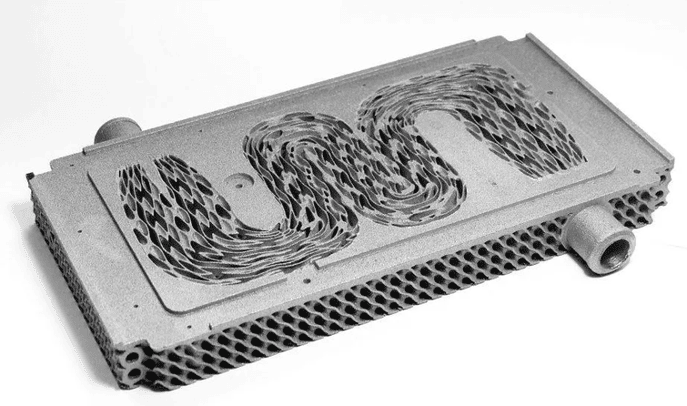
Gyroid lattice design of a cooling plate heat exchanger structure.
Image source: nTop (nTop is cited as an industry example. TGM has no business or organizational ties to nTop.)
The technology
The engineers at Puntozero used the Field-Driven Design Tools from nTop, to create a directed, fin-like flow-guiding geometry. This geometry follows the internal channels of the cooling plate and actively induces turbulence in the coolant at the individual bends. This reduces flow separation, which normally impairs heat transfer when the flow direction changes.
The flow guides consist of a Gyroid Lattice, which was deformed along two axes so that the structure conforms precisely to the flow path. The structure was then thickened and connected to the surrounding outer wall.
Gyroid structures are particularly well-suited for this application: The same Triple-Periodic Minimal Surface (TPMS), which can form as a self-supporting structure during metal printing, also offers an exceptionally high surface-to-volume ratio and thus provides excellent conditions for heat exchange.
Instead, a Diamond TPMS Grid is used.
The finished component was placed on a EOS M 290 manufactured using additive manufacturing with aluminum and then, using CT scan was checked. This confirmed that the geometry was within 200 micrometers was in accordance with the intended design and showed no internal defects.
The lightweight construction aspect
What is particularly interesting about this example is that weight reduction and thermal performance were not pitted against each other—both resulted from the same design decision.
By replacing solid or conventionally ribbed cooling channels with a Gradually adjusted grid design Puntozero was able to vary the wall thickness locally: thicker in the area where it contacts the power electronics—where both stiffness and heat transfer are particularly important—and progressively thinner in the remaining areas, where additional material no longer serves any functional purpose.
The result was a cooling plate that is 25 % lighter compared to the reference solution. At the same time, the flow guides alone made it possible to Increase in heat transfer area by 300 % – in a geometric configuration that would be practically impossible to machine using conventional manufacturing processes.
This example vividly illustrates what becomes possible when lattice structures are viewed not merely as passive filler material, but as active technical surfaces:
The geometry that saves material—and thus weight—is also the geometry that handles the thermal function.
And none of these properties would be possible without the additive manufacturing process used to produce the complex structure.
Case Study Source: nTop — Liquid-cooled cold plate for automotive power electronics
 Deutsch
  English