
The rapid growth of electric mobility is bringing new challenges to machining, particularly when it comes to large stator bores in electric motor housings. These components are typically manufactured on compact CNC machining centers with limited power, where conventional heavy tools compromise machine performance, handling, and productivity.
To meet this challenge, Kennametal developed a lightweight stator boring tool specifically designed for the precision boring of aluminum motor housings. The tool achieves the required dimensional accuracy, roundness, and surface quality while significantly reducing the tool’s weight. This enables easier handling and higher machining efficiency in the production of electric vehicles.
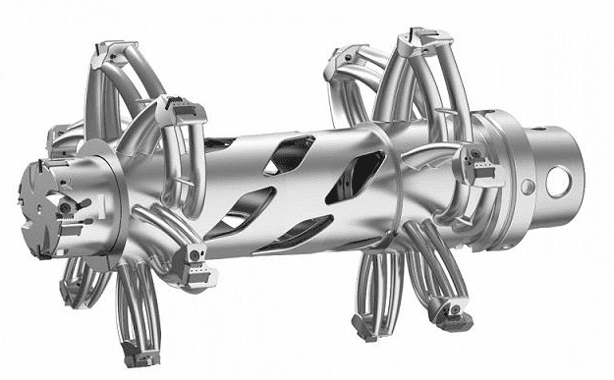
Image source: Canadian Metalworking. (Kennametal is cited as a current industry example. TGM has no business or organizational ties to Kennametal.)
The technology
The lightweight stator drilling tool combines metal additive manufacturing with modern engineering and design methods. The tool is manufactured using metal powder bed fusion and features optimized internal geometries that could not be achieved using conventional manufacturing processes.
A finite element analysis (FEA) was used to optimize the structural design. In this process, the mass of the tool was shifted closer to the spindle to reduce the moment of inertia while maintaining high stiffness.
The design also incorporates internal cooling channels, precisely adjustable RIQ reamer inserts, and a KM4X adapter. This ensures high machining accuracy, longer tool life, and improved process stability.
Another variant replaces the metal tube with a carbon-fiber tube, thereby demonstrating the potential of hybrid material solutions for even greater weight reduction.
The lightweight construction aspect
From a lightweight design perspective, the stator boring tool impressively demonstrates how structural optimization can reduce weight without compromising functional performance.
The conventionally manufactured tool weighed more than 25 kg, while the 3D-printed version weighs only 10.7 kg. The carbon-fiber hybrid version reduces the weight to as little as 9.5 kg. This represents a weight reduction of more than 50 %.
This was achieved through stress-oriented material distribution based on topology optimization principles, the removal of non-load-bearing material areas, and the functional integration of cooling channels directly into the additively manufactured structure.
In addition to improved ergonomics for operators, the reduced mass also lowers the moment of inertia and thus the load on the spindle. At the same time, the machine’s dynamic characteristics are improved, enabling efficient machining on machines with lower power ratings.
This example vividly demonstrates how additive manufacturing and modern lightweight construction principles can fundamentally transform industrial tooling solutions for the next generation of electric mobility.
Read the full article here: https://www.canadianmetalworking.com/canadianmetalworking/news/cuttingtools/kennametal-develops-3d-printed-lightweight-stator-bore-tool
 Deutsch
  English