
The System – Wheel-Based Hydrogen Storage
Agricultural and construction machinery face a particular challenge in the transition to sustainable propulsion systems: They require large onboard energy storage systems while also needing to operate for long periods under demanding conditions.
To address these requirements, HÖRMANN Vehicle Engineering has developed an innovative concept that integrates hydrogen storage directly into the vehicle’s wheel. By utilizing previously unused space within the wheel structure, the system enables hydrogen-powered machines such as tractors to achieve ranges comparable to those of diesel vehicles—with the goal of covering an entire workday without refueling.
The concept was developed as part of the RAHD (Wheel Storage and Drive Function Solution for Heavy-Duty Vehicles) project and aims to accelerate the adoption of hydrogen-powered off-highway vehicles.
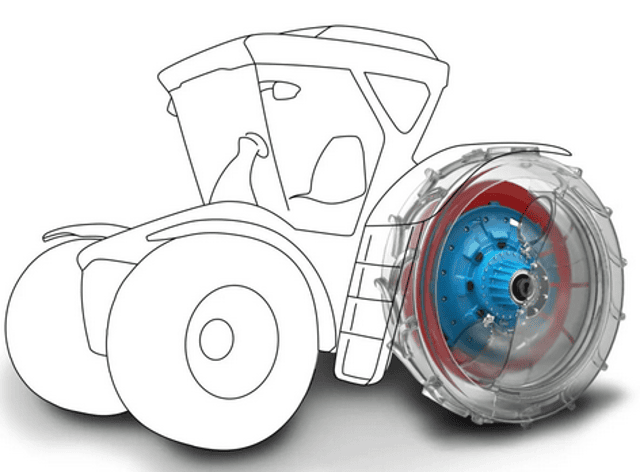
Image source: Hörmann Vehicle Engineering
(Hörmann and the RAHD bicycle concept are cited as current examples from the industry. TGM has no affiliation with Hörmann.)
The technology
This innovation combines two functions within a single wheel module: hydrogen storage and electric propulsion.
Gaseous hydrogen is stored within the wheel structure, while a newly developed electric wheel drive provides propulsion directly at the wheel.
This integrated architecture eliminates the need for large central storage tanks and complex powertrains, resulting in a highly modular vehicle platform.
In addition, the system incorporates reluctance motor technology that does not rely on rare earth elements, thereby combining sustainability with high durability for use in agricultural and construction machinery.
By combining energy storage and the powertrain into a single assembly, the concept opens up new possibilities for future vehicle architectures.
The lightweight aspect
From a lightweight construction perspective, this concept is a classic example of functional integration.
Instead of integrating additional hydrogen tanks into the vehicle—which take up installation space and add structural mass—the system uses an existing vehicle component: the wheel. As a result, the same mounting structure performs multiple functions simultaneously.
This significantly improves packaging efficiency and reduces the need for additional support structures, brackets, and protective elements.
The direct wheel drive configuration also eliminates traditional powertrain components, resulting in a more compact and potentially lighter overall system.
By making maximum use of available installation space and combining storage and propulsion, the concept exemplifies how intelligent system integration can simultaneously increase range, reduce CO₂ emissions, and improve mass efficiency.
This example illustrates a key principle of lightweight design: Not every reduction in weight results from using less material—often, the greatest effect is achieved by combining multiple functions into a single structure.
Link to the original article: https://www.hoermann-engineering.de/en/news/newsmeldung/reinventing-wheel-innovative-storage-and-drive-solution-agricultural-and
 Deutsch
  English