
An ultralight vehicle seat concept impressively demonstrates how carbon fiber is fundamentally reshaping the design of interior structures. Instead of conventional metal-foam constructions, a fully load-bearing CFRP (carbon fiber-reinforced plastic) architecture is used.
The project was developed jointly by key partners such as CSI Development Engineering, Alba Tooling & Engineering, and Automotive Management Consulting as well as other partners from Germany and Austria.
The resulting prototype seat was developed in just seven months has been developed and weighs about 10 kg. The project thus demonstrates a system-oriented lightweight design approach in which structure, ergonomics, and load transfer are integrated into a single composite solution, rather than being distributed across multiple individual components and subassemblies.
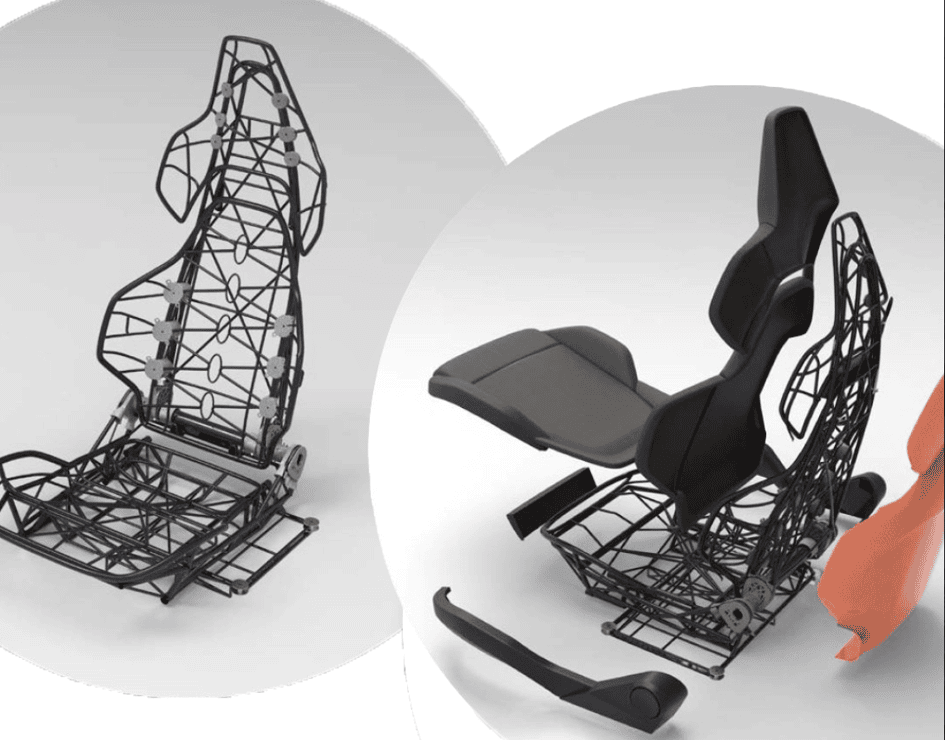
Source: Composites Europe / CSI Development Technology, Alba Tooling & Engineering, and Automotive Management Consulting ( TGM has no business or organizational ties to Composites Europe)
The technology
The key innovation is based on the patented xFK Using the 3D Filament Winding Process, which enables the precise placement of continuous fibers along load paths in three dimensions.
Unlike conventional laminate-based composites, this process produces structures that closely match the final contours, with minimal material waste and particularly efficient use of materials.
Resin-impregnated fibers are wound directly into the final shape. This allows complex seat structures to be manufactured as integrated components without the need for numerous joints or separate assemblies.
This digitally controlled manufacturing approach significantly improves repeatability and enables rapid prototyping while maintaining high structural precision and performance.
The lightweight construction aspect
The seat illustrates a key principle of modern lightweight construction: Design based on actual load paths rather than relying solely on material substitution.
By aligning the fibers along the actual stress paths and eliminating redundant material areas, the CFRP structure achieves a significant weight reduction while simultaneously meeting strength and safety requirements.
The use of carbon fiber further improves performance thanks to its exceptionally high Strength-to-Weight Ratio of the material. This allows the seat's weight to be drastically reduced without compromising the required stiffness.
In addition to weight savings, this approach leads to improved vehicle efficiency, lower energy consumption, and improved dynamic performance.
This example vividly demonstrates how modern composite design and innovative manufacturing processes can transform even traditionally heavy interior components into high-performance lightweight solutions.
Read the full article here: Ultra-lightweight seat features a carbon fiber structure made using 3D winding | CompositesWorld
 Deutsch
  English