
The System – Topology-Optimized Aircraft Door
The aircraft door, developed as part of the collaboration between SOGECLAIR and voxeljet, is a high-load structural subsystem of the fuselage. It ensures cabin pressure integrity, emergency opening functionality, and long-term fatigue resistance.
As part of the primary structure, the door must accommodate complex load paths resulting from pressure cycles, hinge forces, and crash and impact scenarios, while simultaneously ensuring tight tolerances and reliable sealing systems. In this project, the door was not viewed as a traditional assembly consisting of ribs and sheet metal panels, but rather as an integrated load-bearing system in which structural efficiency and manufacturability are optimized together.
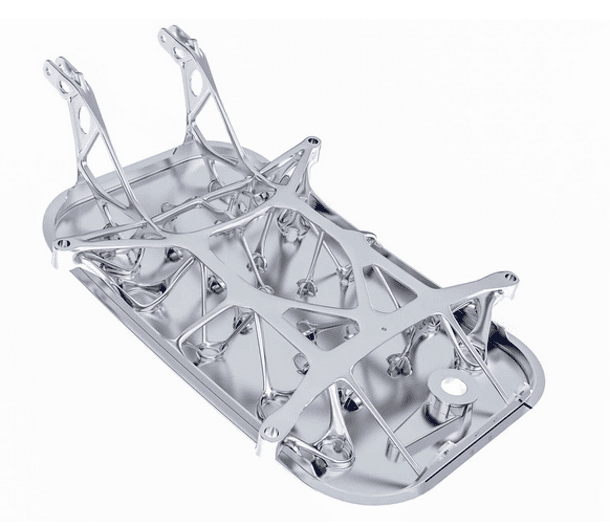
Image source: voxeljet (SOGECLAIR–voxeljet as a current example from the industry; no connection to TGM)
The technology
The development approach combines topology optimization, advanced simulation, and additive-enabled casting processes into an end-to-end digital process chain.
SOGECLAIR's engineering teams used optimization software such as Altair HyperWorks to iteratively analyze various load cases—particularly compressive loads and structural stresses—and determine the optimal material distribution.
The resulting bionic, load-path-oriented geometry was then validated for manufacturability through casting simulation and produced using 3D-printed PMMA models from voxeljet. These prototypes enabled the precise investment casting of aluminum components and combine the design freedom of additive manufacturing with the industrial maturity of conventional casting processes.
The lightweight aspect
The key result of the topology-optimized aircraft door is a significant reduction in structural mass of up to approximately 30 %, while maintaining or improving stiffness and strength.
Material is concentrated exclusively along the primary load paths, eliminating the redundant reinforcement structures found in conventional designs. This not only results in an improved stiffness-to-weight ratio, but also reduces the number of components and simplifies assembly.
From a systemic aviation perspective, these weight savings have a direct impact on fuel consumption and CO₂ emissions over the aircraft’s entire life cycle. This makes topology optimization a key enabler for the next generations of lightweight aircraft structures.
Source article here: https://www.voxeljet.com/additive-manufacturing/case-studies/aerospace/topology-optimization-in-aviation/
 Deutsch
  English