

In our latest TGM Academy newsletter, we explored how modern engineering is evolving from oversized, heavy structures toward intelligent lightweight solutions.
But one important question remained unanswered:
Where do the best lightweight designs actually come from?
The answer to that question has existed for millions of years.
Nature…
Every bone, every shell, every leaf, and every biological structure has evolved with the same design goal that we, too, pursue today:
Maximum performance with minimal use of materials.
This philosophy is emerging as one of the most effective approaches in modern lightweight construction—and that is precisely why bionic design is revolutionizing aerospace, the automotive industry, robotics, additive manufacturing, and complex mechanical systems today.
Please contact us to learn more about our training programs: TGM Academy Info
Purpose of the Study
The aim of this study was to investigate how principles derived from biological structures can be applied to technical applications for optimizing the weight of components.
Rather than simply removing material, the goal is to redesign structures so that every gram effectively contributes to load-bearing capacity—while maintaining stiffness, strength, durability, and manufacturability.
This is one of the core philosophies taught as part of the TGM Academy program on weight optimization.
The Engineering Challenge
Conventional design methods often rely on adding material when greater strength is required.
The result?
- Heavier weight
- Higher manufacturing costs
- More Components
- Lower efficiency
- Lower sustainability
Nature, however, follows a completely different strategy.
Instead of simply making structures thicker, biological systems optimize their geometry, distribute stresses intelligently, and place material only where it is actually needed.
The challenge for engineers is to learn how to apply these principles to modern engineering designs.
Please contact us for information about our training programs: TGM Academy Info
Methodology (Our Approach)
The study combines three complementary engineering approaches.
- Holistic Topography / Topology and Bionics
Natural structures such as turtle shells, mammalian skulls, and seashells were analyzed to understand how geometry influences structural efficiency.
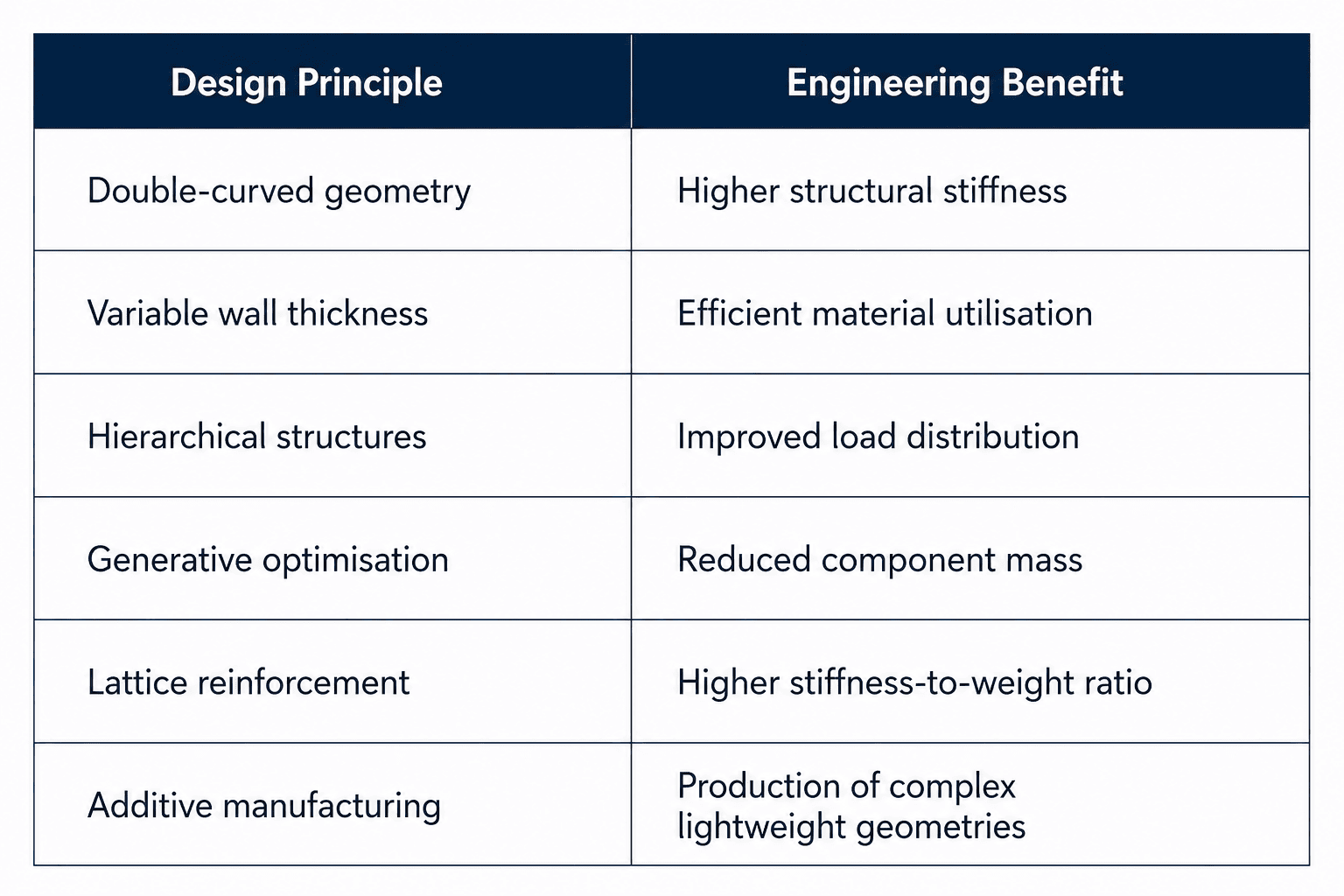
These biological systems demonstrate:
- Optimal Load Paths
- Double-curved shell structures
- Hierarchical Structures
- Efficient Stress Distribution
2. Generative Design
Instead of creating geometries manually, computer-aided algorithms generate optimized structural designs based on technical constraints.
The software determines where material is actually needed and where it can be safely removed.
The result is often an organic geometry that bears a striking resemblance to natural biological forms.
3. Structural Review
Each optimized design is evaluated using technical simulations to verify the following:
- Stiffness
- Voltage Distribution
- Deformation
- Structural integrity
- Weight Loss
- Fertility
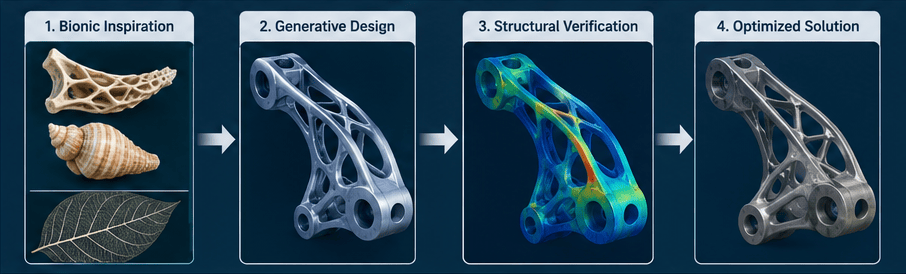
Only designs that meet all technical requirements move on to the production phase.
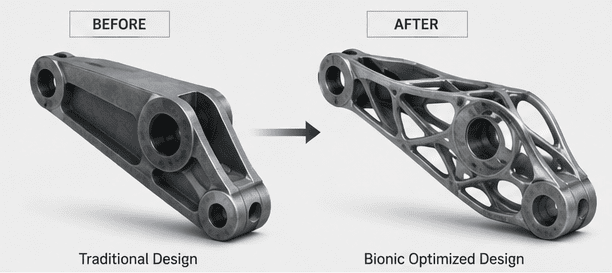
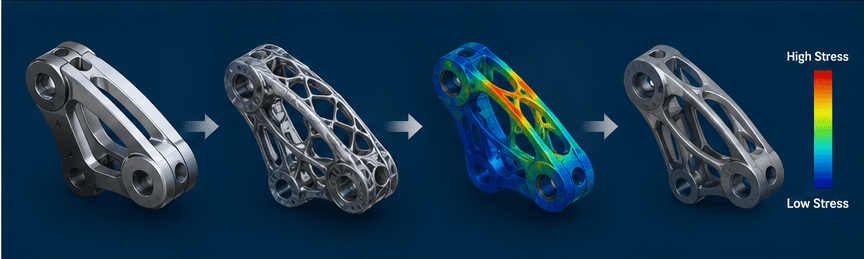
Before-and-After Comparison
The difference is not merely aesthetic.
It fundamentally changes the way loads are transmitted through the structure.
Please contact us for information about training programs: TGM Academy Info
Key Findings
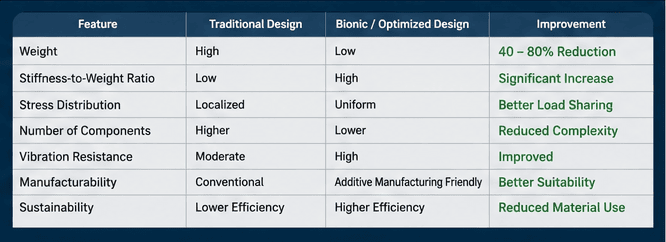
The technical principles examined offer several significant advantages:
- Significant reduction in structural weight
- Higher stiffness-to-weight ratio
- Better stress distribution
- Reduced number of structural components
- Improved vibration resistance
- Greater suitability for additive manufacturing
For many truss and arch structures, depending on the specific application, weight reductions of between 40 % and 80 % can be achieved without compromising structural performance.
For this reason, industries such as aerospace, robotics, motorsports, and modern manufacturing are increasingly adopting these methods.
Key Finding
Weight management is no longer just about removing material.
The point is to understand, where materials should be available—and where they shouldn't.
Nature has spent millions of years solving this optimization problem.
Today's engineers finally have the computer-aided tools they need to apply these same principles through simulation, generative design, and modern manufacturing technology.
The future of structural mechanics belongs to engineers who understand both physics and biology.
Become a part of the TGM Academy
Here at the TGM Academy We are convinced that lightweight construction is no longer merely a niche topic, but is evolving into an essential engineering competency.
The TGM Academy takes a fundamentally different approach and offers a holistic learning experience that encompasses topology optimization, topography optimization, generative design, and bionic optimization. Our programs combine expert-led sessions with hands-on problem-solving, enabling participants to apply advanced technical methods directly to industrial challenges.
Our Weight Management Academy brings together:
- Fundamentals of Engineering
- CAE Simulation
- Structural optimization
- Generative design
- Additive Manufacturing
- Industrial Case Studies
- Proven technical workflows in modern industries
Whether you're a student, an engineer, or an experienced design engineer—our goal is to help you confidently develop lighter, smarter, and more efficient technical systems.
Sign up and contact us to learn more about our training programs: TGM Academy Info
The future of engineering does not belong to those who use the most materials. It belongs to those who know how to make do with the least.
 Deutsch
  English