
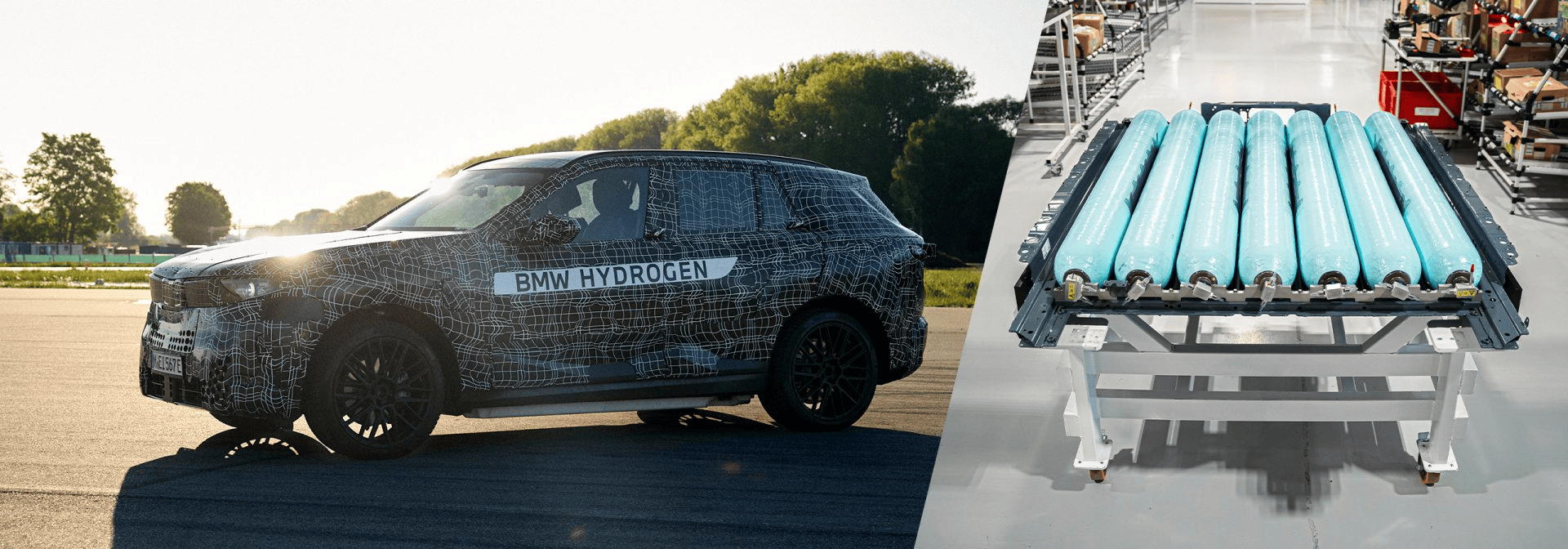
Image source: BMW Group: New refueling system for the BMW iX5 Hydrogen / TGM has no business or organizational ties to the BMW Group.
The hydrogen storage system
In the iX5, the BMW Group is presenting a fundamentally rethought hydrogen storage system: the so-called Hydrogen Flat Storage System. Instead of treating hydrogen tanks as additional components, the system is integrated into the vehicle platform as a structurally and spatially optimized subsystem.
Seven 700-bar high-pressure tanks are arranged in a flat geometry and form a uniform storage module that fits in the same installation space as a Gen6 high-voltage battery. This enables seamless integration into a multi-powertrain vehicle architecture in which hydrogen, battery-electric and hybrid variants can be manufactured on a common production line - without compromising on interior space or packaging.
The technology
At its core, the system is based on a paradigm shift: away from individual pressure tanks and towards a multi-chamber, parallel-connected architecture. The tanks are made of carbon fiber-reinforced composite materials and are integrated into a robust metal frame. They are controlled together via a central valve system and behave functionally like a single energy storage unit.
This configuration improves volumetric efficiency while ensuring structural safety, as the tanks are additionally protected by the surrounding vehicle structure. In total, the system stores around 7 kg of hydrogen and enables refueling times of less than five minutes. This achieves a range of up to 750 km.
In combination with a compact Gen3 fuel cell and a high-voltage battery, a closely coupled electrochemical energy architecture is created - in contrast to a retrofitted integrated system solution.
The lightweight aspect
From a lightweight construction perspective, the innovation lies less in the isolated mass reduction of individual components than in functional integration and systemic efficiency.
The flat tank geometry maximizes space utilization, reduces redundant packaging volumes and enables integration into existing battery compartments. The use of carbon fiber-reinforced composite materials offers high specific strength under 700 bar pressure conditions. At the same time, the structural embedding of the tank system reduces the need for additional protective structures.
Another decisive advantage results from the compatibility with a standardized vehicle architecture: The use of common interfaces for different drive variants reduces system complexity and avoids multiple design of structural components.
The result is a holistic lightweight construction approach in which packaging efficiency, multifunctional structures and material selection work together to optimize both mass and system performance.
Read the full article here:: BMW Group: New BMW iX5 Hydrogen Tank System
 Deutsch
  English