
The System – 3D-Printed Chassis
Hackrod's La Bandita represents a fundamental shift in vehicle development and production. The concept breaks away from traditional automotive development processes and adopts a digitally-centered, user-driven approach.
The system is based on an end-to-end development and manufacturing chain in which design, engineering, and production are interconnected via a cloud-based platform powered by Siemens technologies. Instead of rigid CAD-to-tooling processes, the vehicle is viewed as a digital object that can be continuously refined—one that can be virtually designed, tested, and optimized before a physical component is created.
The result is a co-creation approach in which users, designers, and engineers work together to define the vehicle architecture. This enables extensive customization not only at the design level but also at the system level.
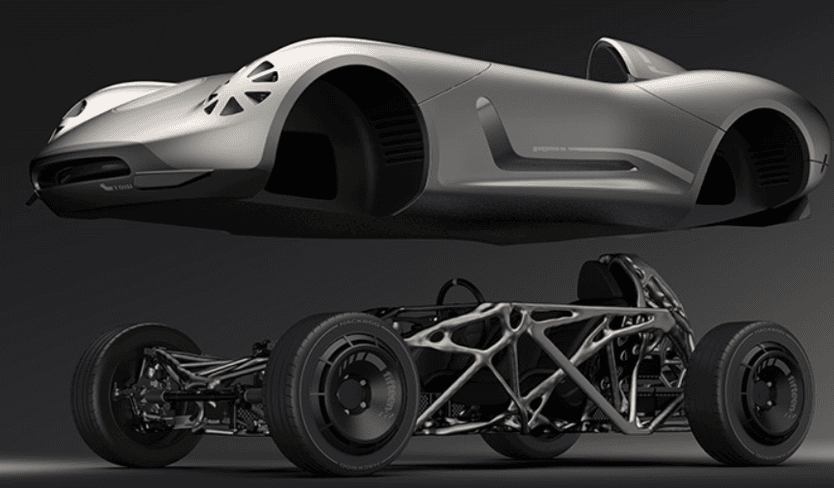
Image source: Hackrod
(Hackrod and La Bandita are cited as current examples from the industry. TGM has no affiliation with Hackrod.)
The technology
La Bandita focuses on the combination of virtual reality (VR), AI-driven development, and industrial additive manufacturing.
The vehicle is first developed entirely in a virtual environment and brought to life. This allows for the evaluation of ergonomics, packaging, and geometry on a 1:1 scale even before production begins.
Siemens' digital engineering environment—including solutions such as NX and PLM systems—enables simulation-driven development processes in which structural behavior, aerodynamics, and load paths are continuously optimized.
Once the digital design phase is complete, manufacturing is carried out using additive manufacturing processes. Large structural components are produced from high-strength aluminum alloys. This approach eliminates many of the limitations of conventional tooling processes and enables geometries that would be difficult or economically unfeasible to produce using forming or casting processes.
The lightweight aspect
The most distinctive feature of La Bandita is its function-driven lightweight construction. This lightweight construction is achieved not merely by using less material, but through computer-aided placement of material exclusively where it is structurally necessary.
The chassis behaves like a digitally generated spaceframe system: In areas subject to high loads—such as around the cockpit and load-bearing transition zones—a denser structure is formed, while areas under less stress transition into open, lattice-like geometries.
This is made possible by topology optimization and generative design. These methods make it possible to remove unnecessary mass while maintaining stiffness and meeting crash safety requirements.
The result is reminiscent of natural load-bearing structures: less like a traditional ladder frame or monocoque, and more like a bone-like load-path system. As a result, lightweight construction is evolving from incremental optimization toward a fundamental structural redefinition.
Source article here: https://www.designboom.com/technology/la-bandita-3d-printed-car-hackrod-03-24-2018/
 Deutsch
  English