
Top-Technologies | Engineering
Issue 02 – March 2026
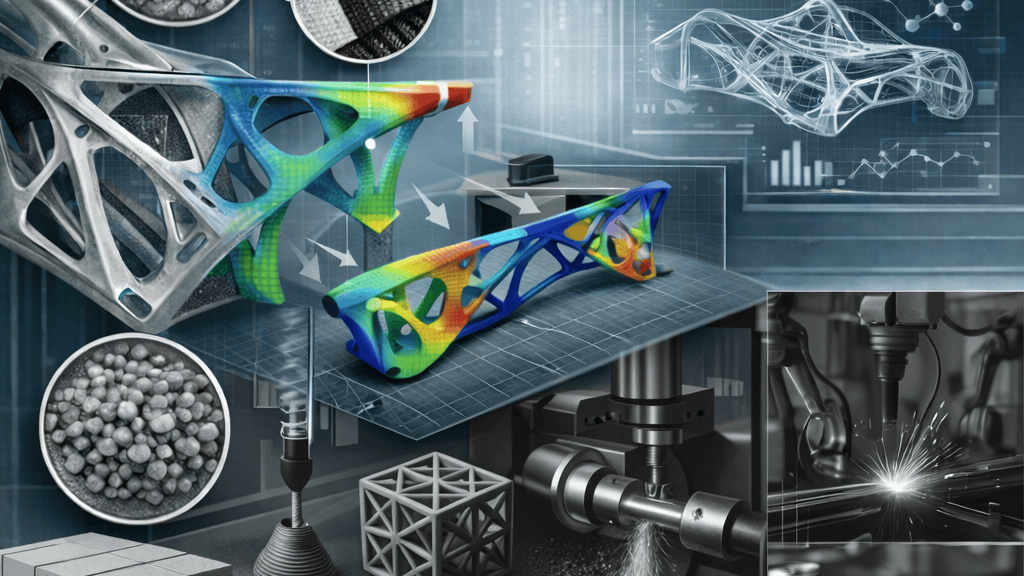
Top technologies in engineering: simulation, FEM analysis, holistic lightweight construction and technical weight management.
Introduction
Artificial intelligence is no longer a forward-looking concept confined to innovation labs and strategy decks. It is already transforming how we approach simulation, computer-aided engineering (CAE), and product development.
In our latest Executive Summary, we examine the most relevant AI technologies for engineering organizations and assess where measurable business value is emerging, as well as where important research and implementation gaps remain.
The following overview summarizes the key insights for 2025 and 2026. The focus is clear: prioritization, practicality, and actionable direction.
AI as a Force Multiplier for Physics-Based Simulation
The most significant advances are taking place at the intersection of high-performance computing and artificial intelligence. Rather than replacing established engineering methods, AI is extending their capabilities and dramatically increasing their efficiency.
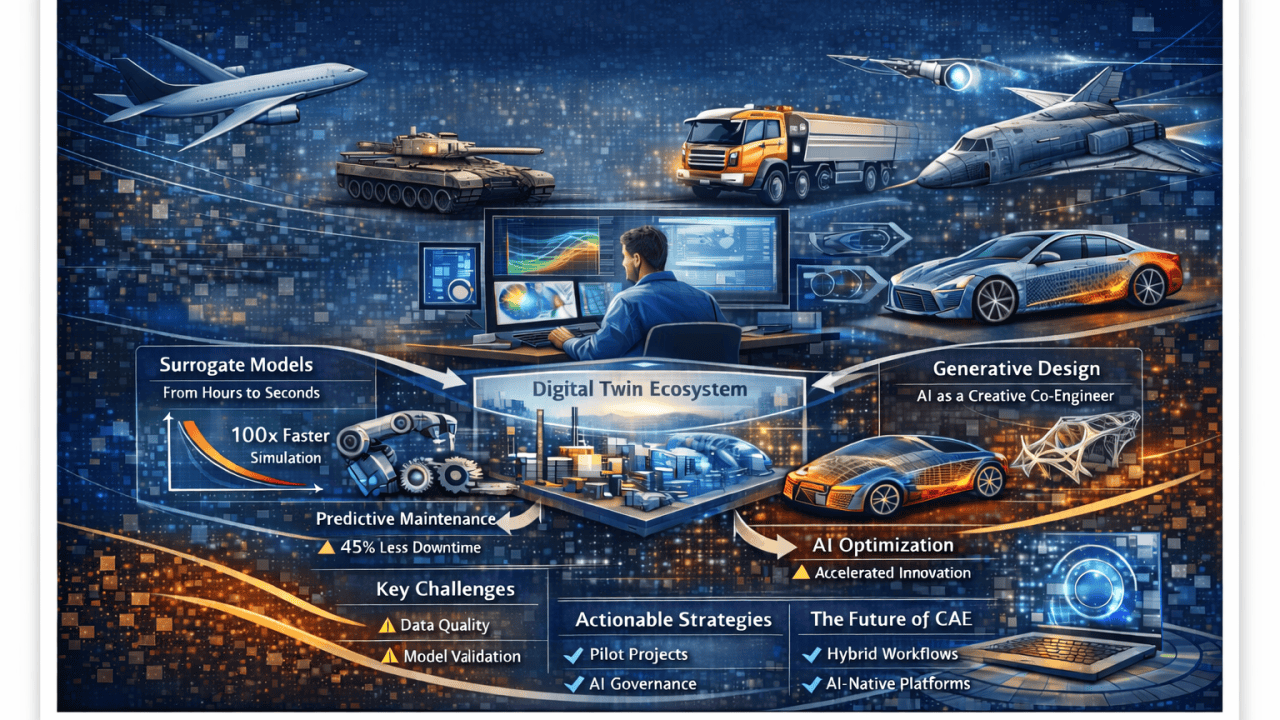
1. Surrogate Models – From Hours to Seconds
Surrogate models use machine learning to approximate computationally expensive simulations such as finite element analysis (FEM) or computational fluid dynamics (CFD). Instead of running full high-fidelity simulations for every design iteration, engineers can rely on trained models that deliver rapid predictions with high accuracy.
The benefits are substantial:
- Acceleration of simulation runtimes by factors of 100 to 1000
- Exploration of design spaces that were previously impractical
- Reduced dependency on costly high-performance computing resources
- Shortened development cycles and faster time-to-market
At the same time, caution is required. The predictive strength of surrogate models is closely tied to their training domain. Outside that domain, performance may decline significantly. Robust validation procedures and clearly defined trust boundaries are therefore essential for industrial deployment.
2. Physics-Informed Neural Networks – Embedding Physics into AI
Physics-Informed Neural Networks (PINNs) integrate governing physical equations directly into neural network training processes. By embedding physical constraints into the loss function, these models aim to combine data-driven learning with established scientific principles.
The potential is considerable:
- Reduced dependence on large training datasets
- Capability to address complex partial differential equations
- Promising applications in multiphysics environments
However, PINNs remain largely in research and pilot phases. Training stability, computational scalability, and application to realistic three-dimensional geometries continue to present challenges that must be addressed before widespread industrial adoption.
3. Generative Design – AI as a Creative Co-Engineer
Generative design has moved beyond experimentation and into industrial practice, particularly in automotive, aerospace, and additive manufacturing environments.
Its value lies in the ability to:
- Achieve radical lightweight structures
- Produce non-intuitive yet high-performance geometries
- Incorporate manufacturing constraints from the earliest design stages
In competitive markets, generative design is no longer a novelty. It is increasingly a differentiating capability.
Digital Twins as the Strategic Backbone
Digital twins integrate simulation models, sensor data, and operational systems into a coherent digital representation of physical assets. Their strategic importance continues to grow.
Market projections suggest that the global digital twin market could expand by approximately USD 163 billion by 2029, with compound annual growth rates near 65 percent.
The impact on engineering and operations can be significant:
- Reduction of unplanned downtime by up to 45 percent
- Advanced predictive maintenance strategies
- Virtual commissioning and process validation
- Earlier integration of simulation into conceptual design phases
At the same time, implementation remains complex. Data harmonization, system interoperability, and organizational alignment are critical success factors.
Technology Maturity and Impact
The Executive Summary provides a structured assessment of technological maturity and industrial impact.
Technologies with high maturity and immediate business relevance include:
- Generative design
- Digital twins
- AI-driven optimization
- Predictive maintenance
Areas with strong long-term potential but continued research demand include:
- Multiphysics AI coupling
- Explainable AI
- Federated learning
- Data-efficient learning
Strategic planning requires balancing short-term value creation with long-term capability building.
Market Signals for 2025
Several developments indicate a clear shift in the engineering landscape:
- Native AI integration within CAE platforms
- Generative AI embedded directly into simulation workflows
- Engineering copilots supporting model setup and validation
- Active learning approaches reducing testing and validation effort by as much as 70 percent
- Increasing convergence of AI architectures and high-performance computing
Taken together, these signals point toward the emergence of AI-native engineering environments.
Key Challenges
Despite strong momentum, important obstacles remain:
- Generalization and robustness: Many AI models perform reliably only within the boundaries of their training data.
- Data scarcity: High-quality datasets remain limited, particularly in multiphysics and nonlinear applications.
- Toolchain integration: Standardized interfaces between AI systems and established CAE tools are often lacking.
- Physical plausibility: Ensuring adherence to conservation laws and physical consistency is essential.
- Governance and validation: AI deployment requires structured quality assurance, version control, and cross-functional oversight.
Addressing these issues is fundamental to scaling AI in engineering responsibly and sustainably.
Practical Recommendations for CAE Teams
Based on our analysis, several concrete steps can accelerate successful adoption:
- Begin with a high-impact pilot project focused on recurring simulation bottlenecks and measurable performance indicators.
- Invest in robust data infrastructure, including structured simulation archives, centralized data lakes, and MLOps frameworks.
- Combine surrogate models with multi-fidelity workflows, using AI for rapid screening and high-fidelity FEM for final validation.
- Apply active learning techniques to prioritize targeted simulations instead of exhaustive parameter sweeps.
- Establish clear AI governance structures, including validation protocols, version control, and defined accountability.
- Close the feedback loop by continuously updating models with operational data from digital twin environments.
AI-Driven CAE Workflow
A future-oriented engineering workflow increasingly follows a closed-loop structure:
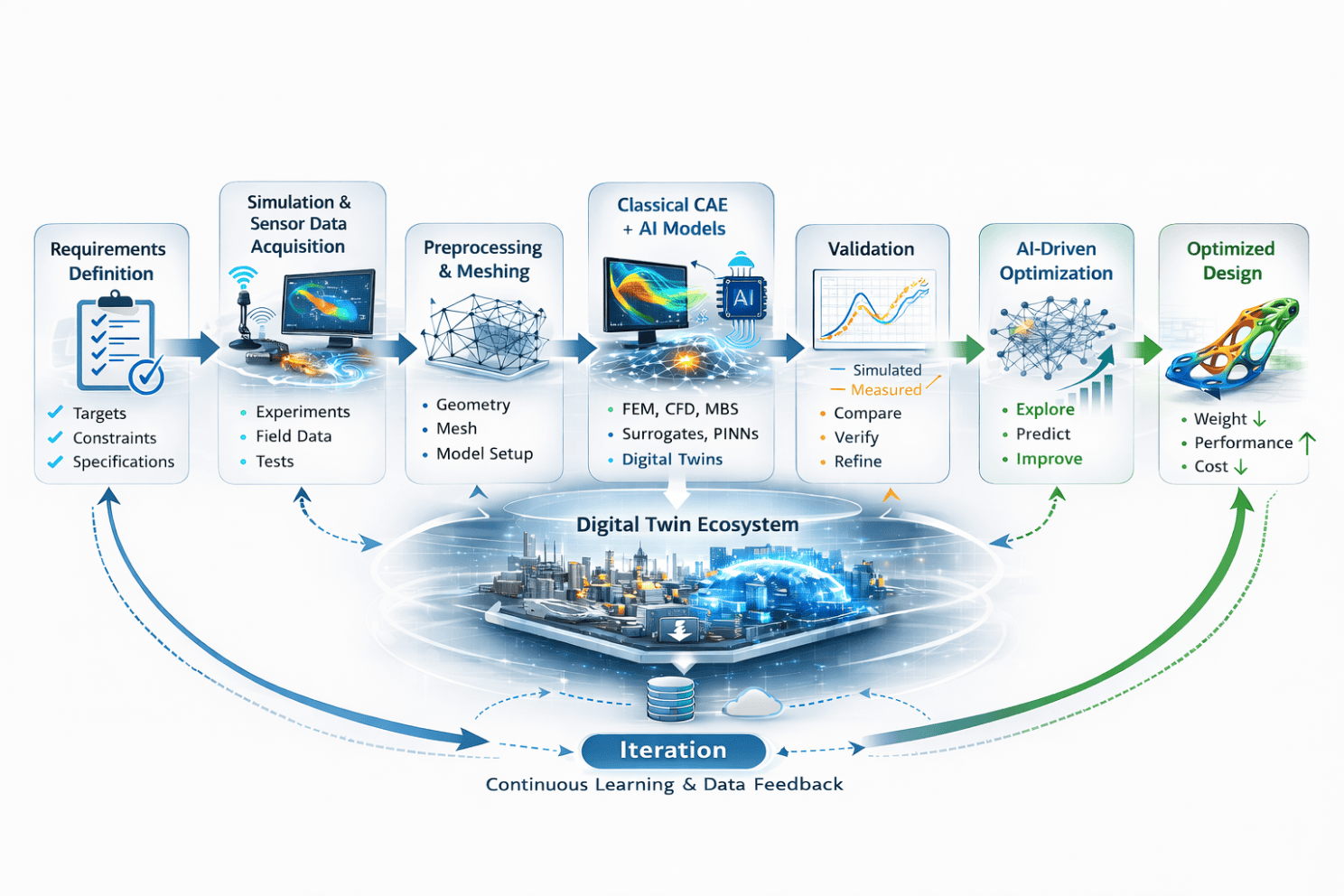
AI Driven CAE Workflow – Closed Loop-Structure (Copyright: TGM)
Such a framework reduces time-to-market while expanding design diversity and innovation potential.
Final Reflections
Artificial intelligence does not replace classical simulation methods. It strengthens and extends them.
The future of engineering lies in hybrid ecosystems that combine FEM, surrogate modeling, digital twins, and active learning within a coherent strategic framework.
The central question is no longer whether AI will transform CAE. The decisive question is how structured, disciplined, and forward-looking that transformation will be within your organization.
I look forward to your perspective:
Where do you currently observe the greatest impact of AI in engineering?
Which pilot initiatives are underway in your organization?
What barriers are slowing implementation?
Let us shape the next phase of engineering innovation together.
Best Regards,
Hans-Peter Dahm
References
Guo, X., Li, W., & Iorio, F. – “Neural Networks for Fluid Flow Prediction” (2021). Demonstrates how deep learning greatly speeds up CFD & simulation tasks. Cite: DOI:10.1016/j.jcp.2021.109638
Bongini et al. – “Machine Learning Surrogate Models in Engineering Design” (2022). High accuracy surrogate models for design space exploration. Cite: Engineering Applications of AI, Vol. 104
Raissi, M., Perdikaris, P., & Karniadakis, G.E. – “Physics-Informed Neural Networks” (Journal of Computational Physics, 2019). Introduced PINNs for solving PDEs using physics constraints. Cite: J. Comput. Phys. https://doi.org/10.1016/j.jcp.2018.10.045
Karniadakis et al. – “Physics-informed Machine Learning” (Nature Reviews Physics, 2021). PINN challenges & future outlook. Cite: Nat Rev Phys 3, 422–440
Autodesk (2023 Report) — Evolution of generative design in industrial workflows. Cite: Autodesk White Paper (https://dam.autodesk.com/autodesk/GD_Industrial_Study.pdf)
Cao et al. – “Feature‐Based Generative Design Using AI” (2022). Practical impact on product lightweighting. Cite: Journal of Mechanical Design
Gartner Digital Twin Research — Digital twin market growth estimates. Cite: Gartner Market Guide 2025
IBM Research — Trends in digital twin adoption & predictive analytics. Cite: IBM Institute for Business Value, 2024
Settles, B. — “Active Learning Literature Survey” (2010). Foundational review for AI sampling approaches. Cite: University of Wisconsin-Madison Technical Report
Foster + Partners + NVIDIA Pilot Study — Active Learning in design simulation. Cite: NVIDIA Technical Brief 2024
 Deutsch
  English